
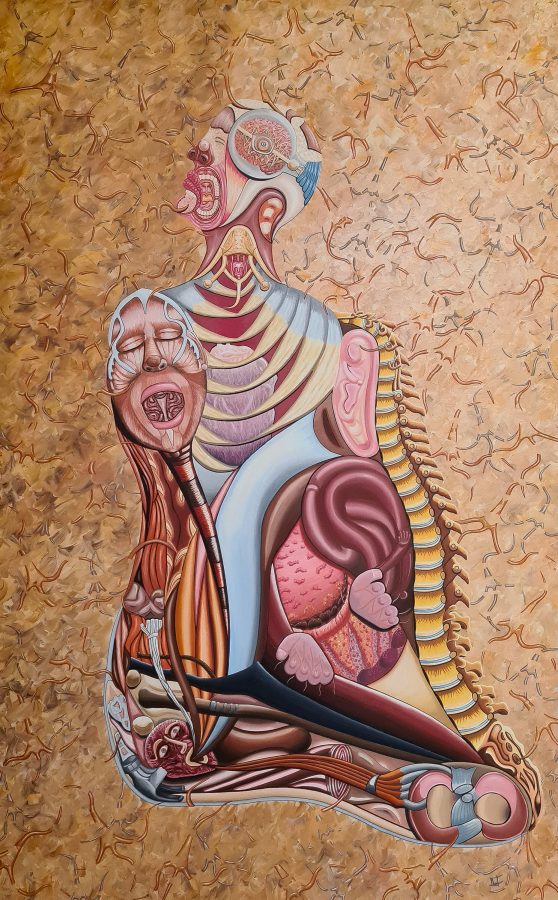
This oil painting titled „The Pain“ presents itself as a profound exploration of human vulnerability through a technique of visual fragmentation that breaks down the figure to map the geography of suffering. Each stroke in the composition seeks to capture the intensity of inner torment, employing a technical precision that lends the elements of the work an almost sculptural presence. Volume is constructed through internal gradients that imbue the figure with a tectonic weight, allowing the represented anguish to acquire a tangible and immersive dimension for the viewer.
The color palette establishes a tense dialogue between the ochre tones of the background and the reddish and pinkish hues that dominate the central anatomy. This intensity is accentuated by contrasts in white and cool blue that provide a rigid structure against the softer, more organic textures. The lighting does not appear to come from an external source, but rather emanates from the folds of the representation itself, creating an atmosphere of isolation that underscores the subject’s solitude in their suffering. The vertical and closed perspective intensifies the sense of introspection and direct confrontation with the work.
In this analysis, the elements of physical decay act as metaphors for existential anguish, transforming the biological into a vehicle for abstract concepts. The rhythmic repetition of skeletal forms functions as an axis of resistance, while the distortion of facial features conveys a magnitude of affliction that transcends the limits of the physical. There is a search in this piece for unity between the structural reality of the body and the vast, invisible landscape of emotional experience, suggesting a spiritual connection amidst the represented collapse.
This large-format composition captures the essence of an emotional state marked by adversity. The dense geometry of the forms creates a visual tension that reflects the internal pressure of human feeling. By synthesizing the fragility of life with a monumental form, the artist transforms a moment of vulnerability into a lasting meditation on the human condition. Every line and every shadow contributes to a powerful vision of the complexity of grief, allowing the weight of pain to manifest with undeniable formal clarity.