
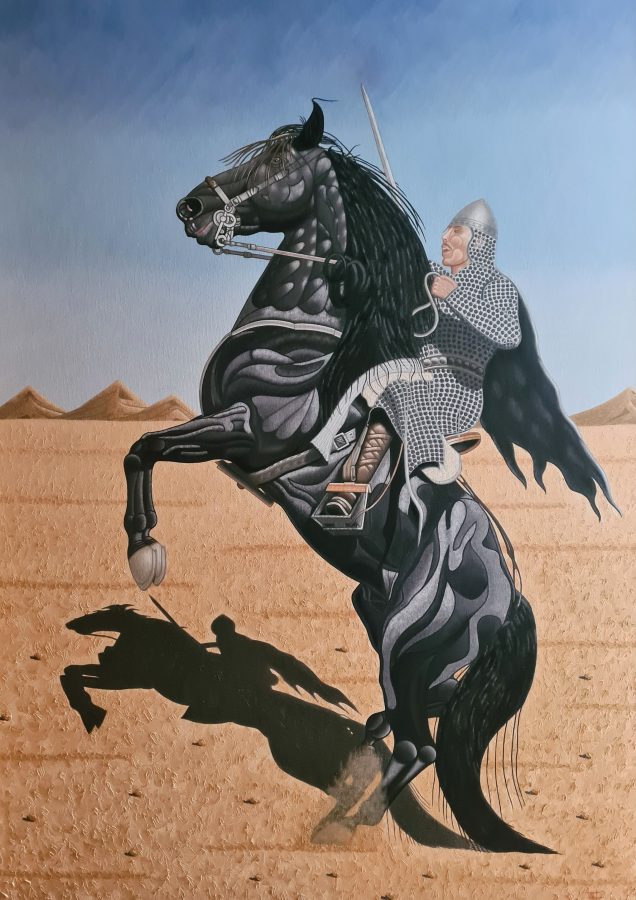
The oil „El Cid Campeador„ emerges as a disciplined exercise in contemporary realism, where historical evocation is articulated through a controlled and highly resolved pictorial language. The composition is dominated by the rearing figure of the horse, whose elevated posture establishes a dynamic vertical thrust against the expansive horizontality of the arid landscape. This deliberate contrast not only stabilizes the composition but also reinforces the heroic centrality of the mounted figure, isolating him within a vast, unadorned terrain that amplifies his symbolic presence.
Technically, the artist demonstrates a refined command of anatomical structure and volumetric modeling, particularly evident in the musculature of the horse. The interplay of light and shadow across its dark coat is handled with precision, producing a sculptural effect that lends the figure both weight and tension. The knight’s armor, rendered through a meticulous patterning of reflective surfaces, introduces a contrasting texture—rigid, luminous, and rhythmically articulated—enhancing the material realism of the scene. The perspective remains intentionally compressed, with a low horizon line that elevates the figures and grants them a monumental quality, while the distant dunes recede with subtle gradation.
Light functions here as a clarifying agent, sharply defining contours and reinforcing the three-dimensionality of forms. The illumination appears direct and unfiltered, consistent with an open desert environment, casting a pronounced shadow that anchors the composition and introduces a secondary narrative silhouette on the land. This shadow, elongated and sharply contoured, not only confirms the spatial logic but also echoes the gesture of the rearing horse, doubling the sense of movement and tension within the scene.
The chromatic palette is deliberately restrained yet effective. Warm ochres and sandy tones dominate the ground plane, contrasted by the cool, desaturated blue of the sky, which provides atmospheric balance without detracting from the central figures. The deep blacks and greys of the horse act as a visual fulcrum, concentrating the viewer’s attention, while the metallic highlights of the armor introduce controlled accents of luminosity. Collectively, these elements coalesce into a visual statement that transcends mere representation, evoking themes of valor, isolation, and historical myth through a synthesis of technical rigor and compositional clarity.