
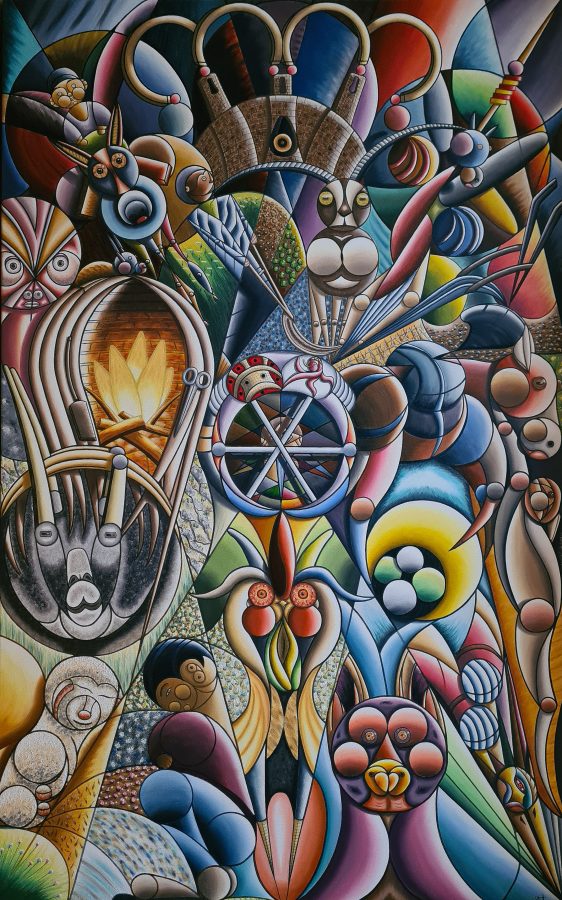
A luminous architecture of memory unfolds in this composition titled “Childhood“, where the artist translates the ephemeral nature of early experience into a stable, geometric reality. Technically, the work is characterized by a playful yet rigorous compartmentalization of form, creating a visual playground where each segment acts as a self-contained vessel of color and light. The handling of volume is exceptionally soft, utilizing internal gradients and curved hatching to give the various whimsical figures and abstract shapes a pneumatic, tactile presence that evokes the soft edges of youth and the comforting weight of toys.
The color palette is a vibrant celebration of innocence and discovery, dominated by saturated primary tones and warm, sunset-hued ambers that suggest the protective glow of a hearth. Light does not emanate from an external source but seems to radiate from within the elements themselves—most notably from the campfire-like flame contained within an oval structure on the left, which serves as a beacon of warmth. This internal luminescence, combined with a layered and non-linear perspective, creates a sense of magnitude that reflects a child’s perception of a world that is at once intimate and boundless. The chromatic balance between the cool blues at the base and the fiery yellows of the center establishes a dynamic harmony that guides the eye through a forest of symbols.
This piece serves as a profound allegory of growth and the formation of the self, potentially drawing from the artist’s own formative years to build a universal map of wonder. Through concrete elements such as the stylized, toy-like animal faces, the glowing fire, and the central wheel-like motif, the work communicates abstract concepts of discovery, safety, and the spiritual unity of a life’s beginning. The density of the iconography suggests a mind that is actively categorizing its environment, turning simple objects and faces into the foundational pillars of a personal mythology.
The composition stands as a masterful synthesis of nostalgia and analytical realism. The rhythmic repetition of circular and ovoid forms creates a gentle, pulsing energy that suggests the safety of the cradle and the cyclical nature of time. By elevating these potentially autobiographical memories into a monumental and structured visual language, the artist invites the viewer to reconnect with their own internal history. It is a striking representation of how the complexities of the past can be stabilized into a singular, radiant vision of unbreakable joy and enduring curiosity, ensuring that the fleeting magic of the early years is preserved with a tectonic permanence.